You have a small apartment and need a spare bed for weekend guests. Or a home office that doubles as a guest room twice a year. Or a hotel that needs flexible overflow sleeping. You already own a rollaway bed—or you are about to buy one—and the mattress feels too thin. Or too thick: the bed won’t fold Rollaway Bed Mattress Thickness.
This is not a matter of preference alone. Pick the wrong thickness, and the bed won’t close, your guest will wake up with back pain, or the frame will break. This guide uses manufacturer specs, safety data, and real failure reports to give you a thickness answer you can trust
Table of Contents
The Single Most Important Decision Factor
For rollaway beds, mattress thickness is not about luxury. It is about whether the bed can fold safely and support sleepers without damaging the frame. The trade-off is simple: thicker foam feels more comfortable but may prevent the frame from locking closed. Thinner foam folds easily but can feel like plywood.
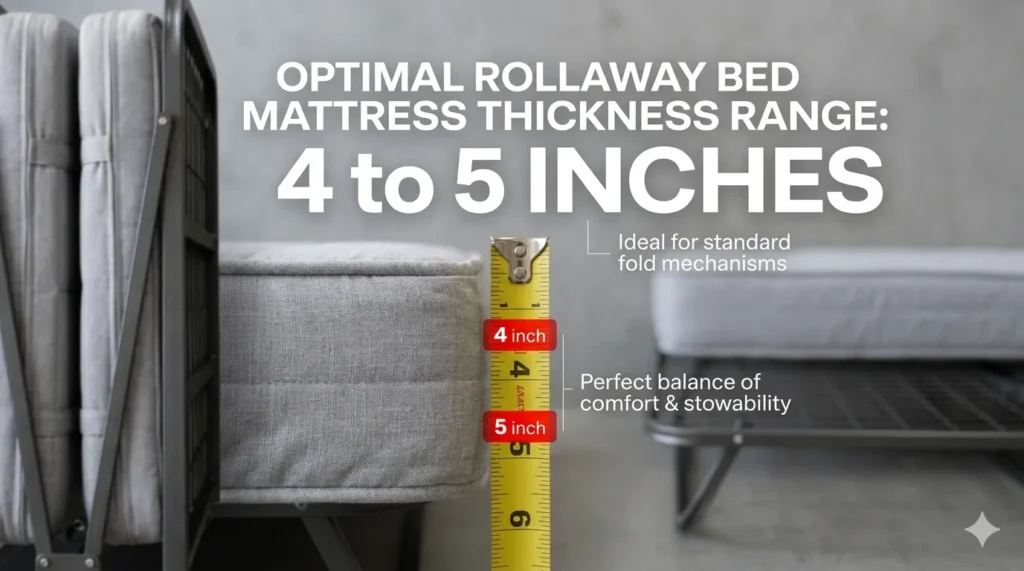
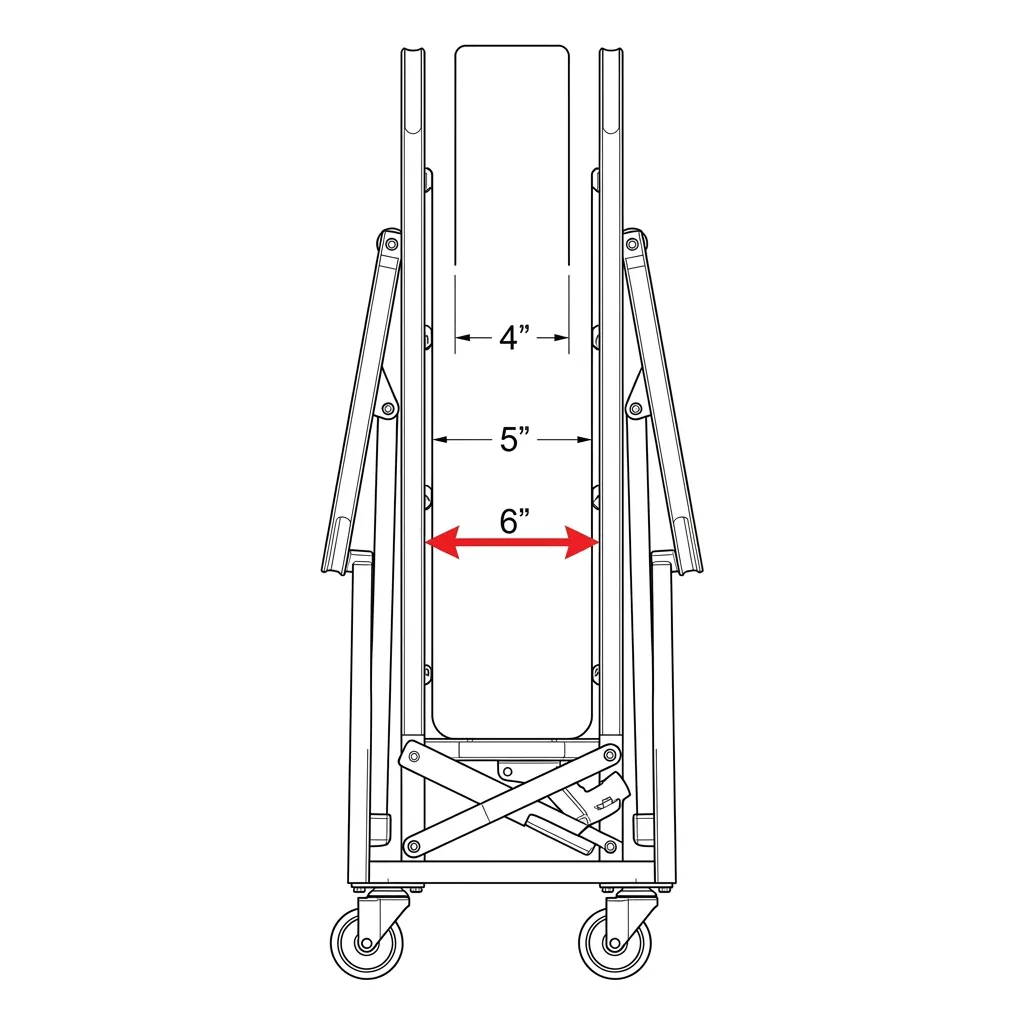
The deciding factor is frame clearance—how much vertical space the folding mechanism allows when closed. Most rollaway frames are engineered for a mattress depth of 4 to 6 inches. Exceeding 6 inches risks breaking the hinges or straining the folding strap.
What this means for you: Before shopping for a replacement mattress or evaluating a new rollaway bed, measure the closed height of the frame’s mattress platform. If you cannot verify the frame’s maximum thickness, stay at or below 5 inches.
Verified Thickness Ranges from Manufacturer Specs
The research below comes directly from manufacturer listings and major retailers. All dimensions are verified.
| Brand / Model | Mattress Thickness | Construction | Folded Thickness |
|---|---|---|---|
| LUCID (cot size) | 4 inches | 1″ memory foam + 3″ support foam | Not specified |
| LUCID (Twin XL) | 4 inches | 1″ memory foam + 3″ support foam | Not specified |
| Milliard Diplomat | Up to 5 inches | Dual-layer memory foam + support foam | 14 inches (frame + mattress) |
| Milliard Lightweight Cot | Up to 5 inches | Medium firm foam | 12 inches |
| Amazon Basics Premium | 4 inches | Memory foam | Not specified |
| DHP | 5 inches | Not specified | Not specified |
| ZAFLY (extra wide) | 5 inches | Memory foam | Not specified |
Industry thickness ranges for rollaway / trundle beds:
- 2–5 inches: Standard for low-profile cots and basic rollaways
- 4–6 inches: Ideal for everyday guest use (balance of comfort and foldability)
- 6+ inches: Maximum comfort but may not fit; verify frame clearance first
Spec → Function → User Impact
Translate every number into what it actually means when you unfold the bed at 11 PM.
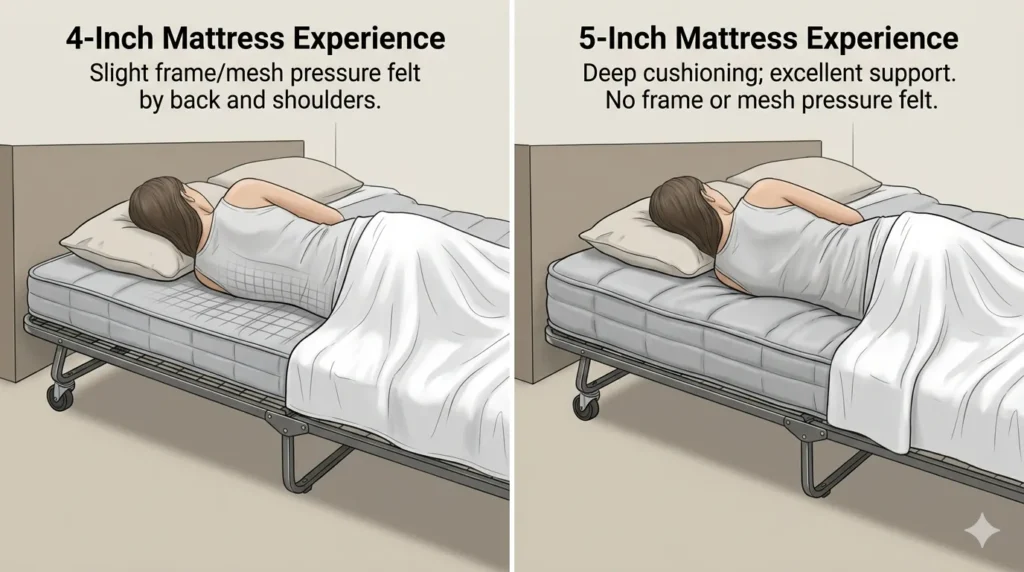
4-Inch Mattress
Spec: 4 inches of foam (example: LUCID’s 1” memory foam + 3” support foam)
What it means in use: The bed will fold easily and lock securely. The mattress feels firm but has a thin comfort layer. Most users describe it as “acceptable for one to three nights.”
Who it matters for: Homeowners with very small storage closets (folded bed thickness around 12–14 inches). Hotels needing durable, replaceable units. People who host guests only a few times per year.
5-Inch Mattress
Spec: 5 inches of foam (example: Milliard Diplomat, DHP, ZAFLY)
What it means in use: The bed may require a bit more effort to close, but still fits most standard frames. The extra inch provides noticeably better pressure relief for side sleepers and heavier adults.
Who it matters for: Frequent hosts (monthly or more). Families with teenagers or larger guests. Anyone who has slept on a 4-inch rollaway and thought, “I felt the bars.”
6-Inch Mattress
Spec: 6+ inches (no major brand currently sells a 6-inch rollaway mattress as a standard paired unit)
What it means in use: You are likely looking at a replacement mattress for a non-folding platform bed or a trundle drawer. For a true folding rollaway frame, 6 inches is risky.
Who it matters for: Only buyers who have measured their specific frame’s closed clearance and confirmed compatibility. Do not assume.
Weight Capacity and Thickness: Not the Same Thing
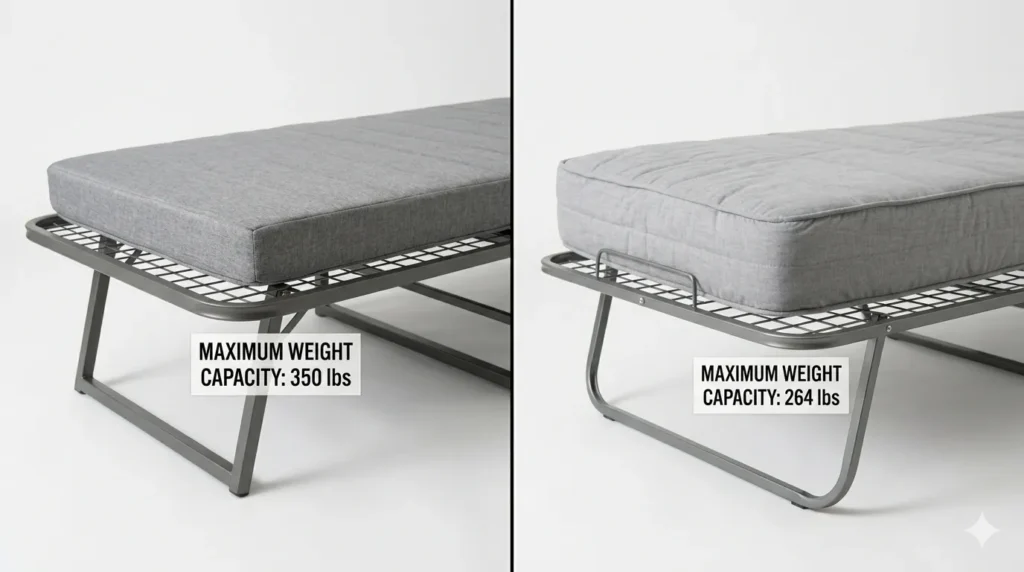
A thicker mattress does not mean a stronger bed. Weight capacity is determined by the frame, not the foam.
| Brand | Weight Capacity | Frame Material | Mattress Thickness |
|---|---|---|---|
| LUCID | 350 lbs | Alloy steel | 4 inches |
| Milliard Diplomat | 300–400 lbs (varies) | Full-steel wire lattice | Up to 5 inches |
| Best Choice Products | 350 lbs | Metal / steel | 4 inches |
| Greenvelly | 450 lbs | Not specified | Not specified |
| Giantex | 485 lbs | Not specified | Not specified |
| ZAFLY | 330 lbs | Steel | 5 inches |
User impact: A 4-inch mattress on a 350-lb frame (LUCID) will support a heavier adult than a 5-inch mattress on a 264-lb frame (Milliard Lightweight Cot). Do not prioritize thickness over weight capacity if you regularly host guests over 250 lbs.
Who this matters for: Hotel buyers, caregivers for bariatric patients, families with large teenagers, and anyone who has had a rollaway collapse (see failure points below).
Material Matters More Than Thickness Alone
Thickness is one variable. Foam type determines how that thickness performs.
Memory Foam (Most common in 4–5” rollaway mattresses)
- Function: Conforms to body, reduces pressure points.
- Trade-off: Retains heat. Look for cooling gel or open-cell foam if your guests complain of sweating.
- Examples: LUCID, Milliard, Amazon Basics, ZAFLY.
High-Density Polyurethane Foam
- Function: Affordable, lightweight, decent support.
- Trade-off: Less durable than memory foam. Compresses faster with frequent use.
- User impact: Fine for twice-a-year guests. Not for daily use.
Latex Foam (Rare in rollaway beds)
- Function: Breathable, supportive, mold-resistant.
- Trade-off: Heavier and less flexible. Harder to fold. Not commonly found in sub-5” thicknesses.
Hybrid (Foam + Coils)
- Function: Best support and comfort.
- Trade-off: Very heavy. May not fold at all. Most manufacturers avoid hybrids for rollaway frames.
Bottom line: For a 4-inch rollaway mattress, memory foam with a support core (like LUCID’s 1” + 3” construction) is the most comfortable verified option. For a 5-inch mattress, dual-layer memory foam (Milliard) provides better longevity.
What Happens If You Choose the Wrong Thickness?
Escalation of consequences – from annoyance to injury.
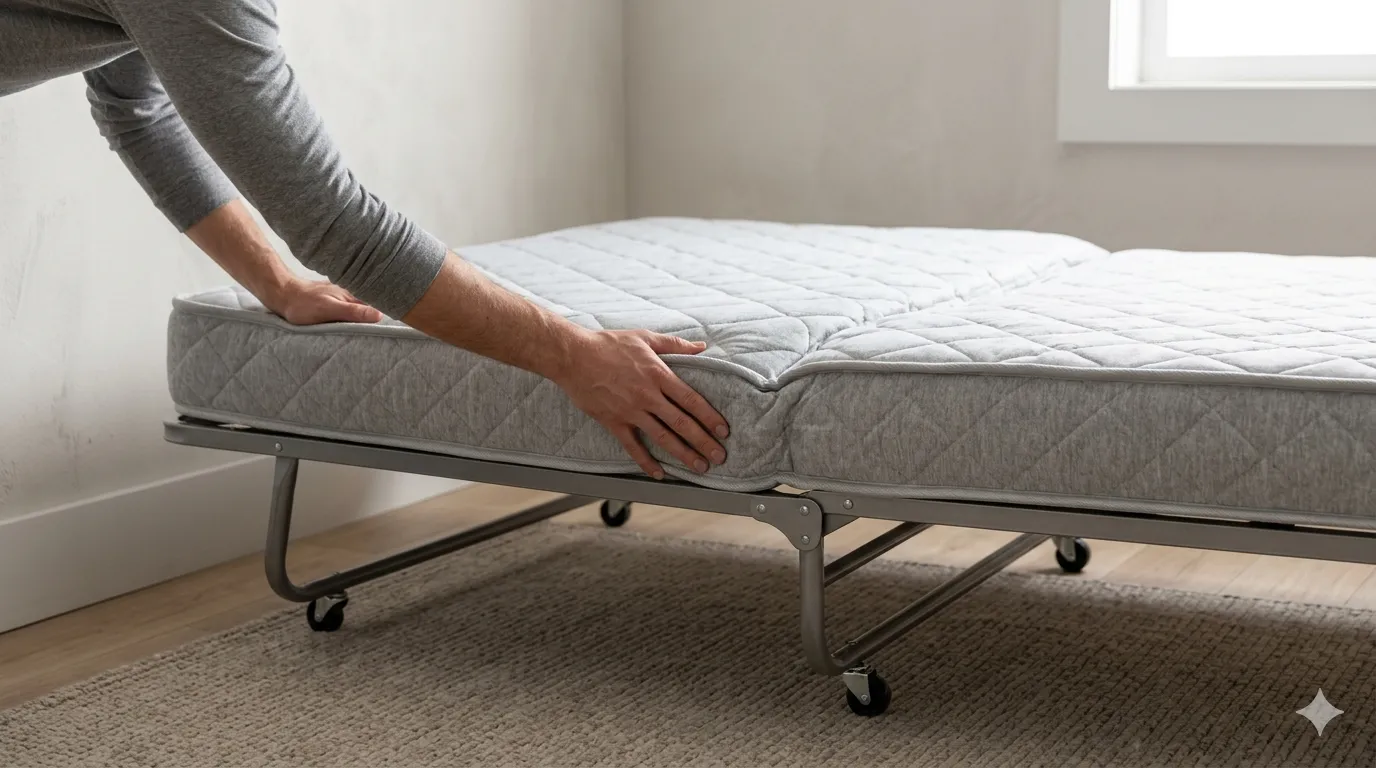
Consequence 1: The bed will not fold closed.
You force it. The nylon strap with plastic clip (a common failure point noted in customer reviews) breaks. Now the bed cannot be stored. You have a permanently unfolded rollaway bed taking up floor space.
Consequence 2: Hinge or leg failure.
A too-thick mattress pushes against the folding mechanism when closed. Over time, the hinges become unstable. Alignment shifts. Customer reviews from verified buyers report: “Hinges not stable,” “Middle collapse after 3 months,” “Leg inserts not glued – legs fell off, front of bed collapsed.”
Consequence 3: Back pain for your guests.
A mattress that is too thin (under 4 inches) on a wire lattice frame means sleepers feel the bars. One aggregated review stated: “Frame and mattress sag under 200 lb user. Mattress described as pretty thin and pretty low to the ground – more suitable for camping than guest use.”
Consequence 4: Frame collapse and injury.
In extreme cases, the combination of wrong thickness + excessive weight + poor manufacturing leads to collapse. The LUCID platform bed recall (September 2024) involved 137,000 beds breaking and collapsing, with 18 injuries reported. While that recall was for platform beds, not rollaway beds, it demonstrates that folding bed mechanisms can fail when stressed. The 2019 LUCID recall of 86,000 folding mattress sofas was due to flammability failure – a different but serious safety issue.
No active CPSC recalls specifically for rollaway beds exist today. But the failure points are documented in thousands of customer reviews: missing pre-drilled holes, poor welding, broken joints upon arrival, wheels without locking mechanisms.
Safety Certifications: What to Look For
Do not trust “certified” without verification. Here is what exists in the verified research.
| Certification | Meaning | Verified on Rollaway Beds? |
|---|---|---|
| CertiPUR-US | Foam tested for safety of materials, emissions, and durability | Yes – LUCID, Amazon Basics |
| GREENGUARD Gold | Screened for 10,000+ chemicals and low VOCs | [UNVERIFIED] for specific rollaway models |
| JPMA | Juvenile product safety – focus on cribs, strollers, car seats | [UNVERIFIED] – JPMA does not typically certify rollaway beds |
User impact: CertiPUR-US ensures the foam contains no heavy metals, formaldehyde, or phthalates. This matters if your guest room is also a nursery or if you have chemically sensitive guests. Without certification, you have no guarantee.
Price and Warranty Reality (April 2026)
Rollaway beds are sold as complete units (frame + mattress). Standalone rollaway mattresses are rare.
| Brand / Model | Retailer | Price (as of April 2026) | Warranty |
|---|---|---|---|
| Milliard Diplomat | Bed Bath & Beyond (Canada) | CAD $732.69 | [UNVERIFIED] |
| Milliard Lightweight Cot | Bed Bath & Beyond (Canada) | CAD $299.04 | [UNVERIFIED] |
| LUCID (cot size) | Amazon / Desertcart | Currently unavailable or not listed | 10-year limited (frame only) |
| Best Choice Products | eBay | Not listed | [UNVERIFIED] |
| DHP (5” mattress model) | Walmart | Not listed | [UNVERIFIED] |
Typical warranty range for rollaway beds: A few months to several years. LUCID offers a 10-year limited warranty covering manufacturing defects in the frame. Most budget brands do not publish warranty terms.
User impact: A $300–$700 rollaway bed with a 4–5” mattress is a mid-range purchase. If you pay under $150, expect a 3” or 4” low-density foam that will sag within 1–2 years of occasional use.
Assembly Time and Tools – What Thickness Changes
Mattress thickness does not affect assembly time, but it affects how easily the bed closes after assembly.
| Assembly step | Time | Tools |
|---|---|---|
| Unpack and identify parts | 5–10 minutes | None |
| Attach legs and hinges | 15–30 minutes | Allen key (included), sometimes screwdriver |
| Place mattress | 2 minutes | None |
| Test folding mechanism | 2 minutes | None |
First-time assemblers: Add 15–30 minutes.
Complex queen rollaway beds: Up to 1 hour.
Fully assembled out of box: Some models (The Hooman Life reports 5–10 minutes total, no tools).
Critical check after assembly: Fold the bed with the mattress in place. If you feel resistance or hear creaking from the hinges before the bed is fully closed, the mattress is too thick. Stop. Do not force it.
Common Failure Points Directly Linked to Mattress Thickness
From aggregated verified customer reviews across Amazon, Walmart, and eBay:

Thickness-related failures:
- Nylon strap with plastic clip breaks when forcing a thick mattress closed.
- Hinges become unstable; alignment shifts over time.
- Middle of frame collapses after repeated forced closures (as few as 3 months).
Not thickness-related but worth knowing:
- Missing nuts and bolts in hardware packs.
- Leg inserts not glued – legs fall off.
- Wheels lack locking mechanisms; bed rolls during use.
- Missing pre-drilled holes – customers must drill their own.
User impact: A 4-inch mattress on a quality frame (LUCID, Milliard) has fewer reported closure failures than a 5-inch mattress on a budget frame. If you choose 5 inches, verify the frame brand’s stated maximum thickness.
Decision Summary: Which Thickness Is for You?
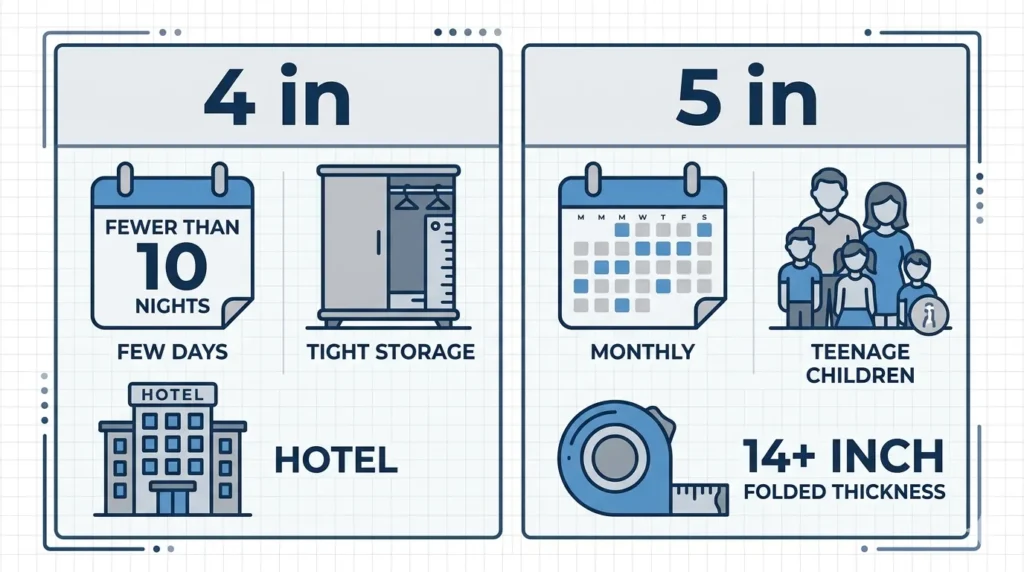
Choose a 4-inch rollaway mattress if:
- You host guests fewer than 10 nights per year.
- Storage space is extremely tight (folded bed thickness 12–14 inches).
- You are buying for a hotel or rental property where durability and replaceability matter more than plush comfort.
- The frame’s weight capacity is your primary concern (e.g., LUCID’s 350 lbs on a 4-inch mattress).
Not for: Side sleepers over 200 lbs, guests with chronic back pain, or anyone expecting hotel-level mattress thickness.
Choose a 5-inch rollaway mattress if:
- You host guests monthly or more often.
- The frame is specifically rated for 5 inches (Milliard Diplomat, DHP, ZAFLY).
- Your guests include teenagers, average-weight adults, or side sleepers.
- You have room for a folded bed thickness of 14 inches or more.
Not for: Bariatric use over 300 lbs (check individual frame limits – Milliard Lightweight Cot is only 264 lbs), or extremely tight closets.
Avoid 6-inch or thicker mattresses unless:
You have measured your specific frame’s closed clearance and found 6 inches explicitly approved by the manufacturer. No major brand currently sells a 6-inch rollaway mattress as a standard paired unit. If you add a third-party 6-inch mattress, you assume all risk of hinge failure, collapse, and voided warranty.
Final Verdict
For the vast majority of buyers, 4 to 5 inches is the correct thickness range. Four inches works for light, infrequent use and tight storage. Five inches provides noticeably better comfort for frequent hosting and average-weight adults.
Do not buy a rollaway bed without checking the frame’s maximum mattress thickness. Do not assume thicker is better. And if you already own a rollaway bed with a 3-inch mattress that guests complain about, replace it with a 4-inch or 5-inch memory foam mattress only after confirming frame clearance.
Your guests may not remember the brand of the bed. They will remember a good night’s sleep – or a bad one. Thickness is the difference.